Linkup ST Achieved 6% Revenue Growth Despite a Decline in the Ukrainian IT Market
The challenge
In 2024, Ukraine's IT services export revenue decreased by 4.2% to $6.45 billion, bringing $279 million less to the Ukrainian economy compared to 2023, according to the National Bank of Ukraine.
For Linkup ST, a company that had been steadily growing since 2013, this market pressure became a turning point. While others were downsizing, Andriy Sambir, the CEO of Linkup ST, chose to strengthen the company's consulting capabilities and position Linkup ST as a one-stop shop for business growth. With 3 key services: marketing, UX, and digital transformation.
To enable this shift, Linkup ST had to deliver strategically, consistently, and at scale. But two obstacles stood in the way:
→ Top managers at Linkup ST lacked the strategic competencies needed to standardize delivery operations.
→ Client ownership was fragmented. There was no dedicated AM function, and most strategic client decisions sat with the CEO. This limited proactive account development and upsells.
Linkup ST needed systematic leadership development and defined AM structure. That’s when they turned to Wiseboard to help turn their vision into operational excellence.
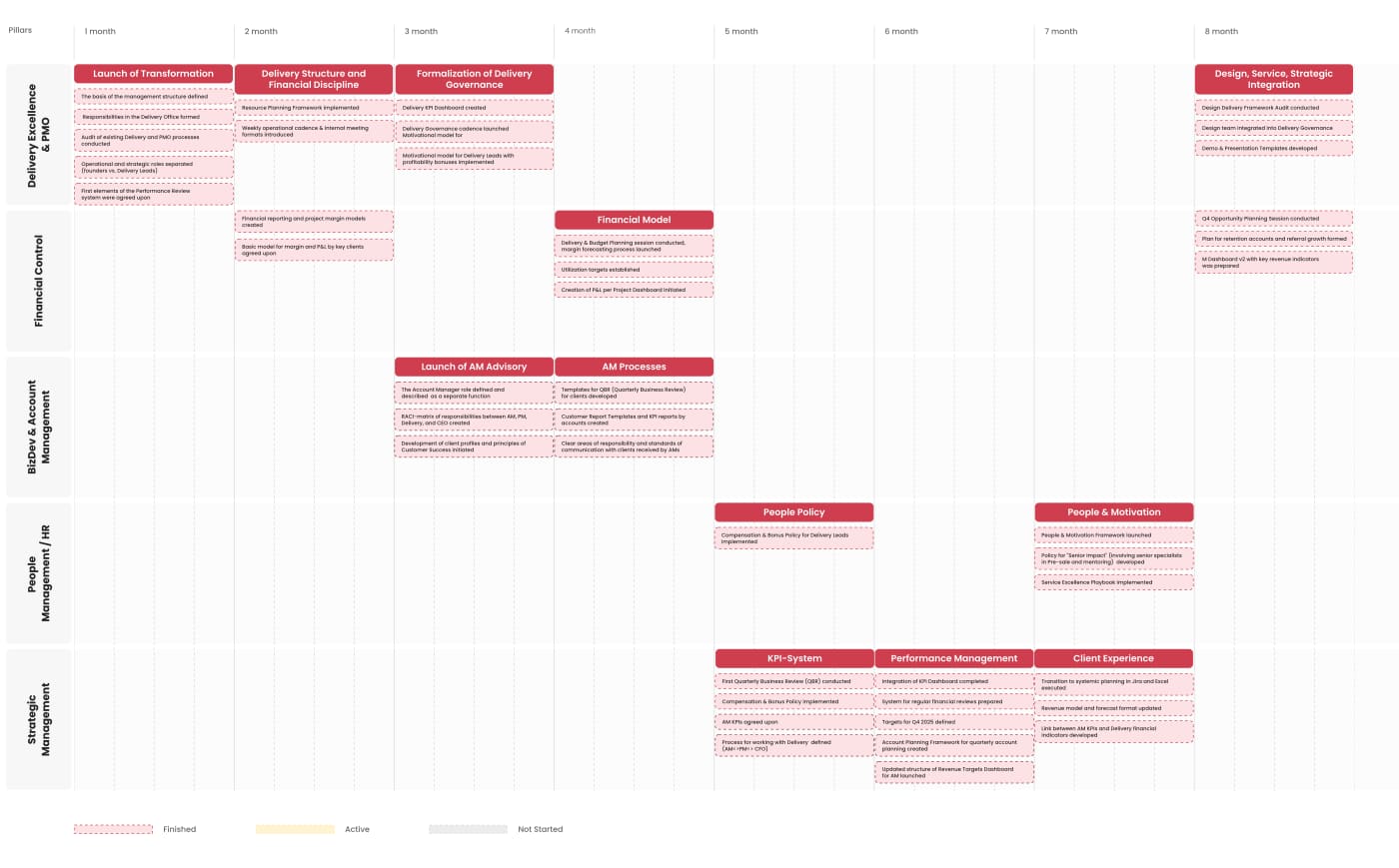
Transformation scope
Wiseboard brought in Denys Rudenko, an experienced advisor with over 13 years in the IT industry. In their first meeting, Andriy was direct about what he didn't want: outside executives brought in to replace his team or pressure to restructure from scratch. He wanted to invest in the existing managers and team leads who already knew the business, clients, and teams.
After assessing Linkup ST's organizational structure and management maturity, Denys supported this direction, and they got down to work.
“When I first looked at Linkup ST, I could see the potential, but the processes weren’t there yet. We had to get delivery under control and make the KPIs visible.”
 Denys RudenkoWiseboard advisor
As delivery and AM are closely interconnected, Denys and Linkup ST’s team introduced the AM role early in the engagement. As it took shape, Zhanna Maksiutenko, Wiseboard AM advisor, joined the project to strengthen the process and align it across departments.
“Over just four months, we built Linkup’s Account Management function almost from scratch. That progress wouldn’t have been possible without Iryna, the Account Manager, and Andriy’s steady support as CEO. Their commitment made all the difference.”
 Zhanna MaksiutenkoWiseboard advisor
Zhanna's task was to clarify the scope of the AM role, integrate it within the organization, and develop strategies to manage and scale strategic client relationships.
While Zhanna helped Linkup ST build the AM infrastructure, Denys worked with the CEO and Chief Delivery Officer on the financial and operational sides. Denys and Zhanna conducted workshops, identified blockers, and provided recommendations to overcome them.
Below is a breakdown of how Wiseboard advisors helped Linkup ST achieve their goals.
“Partnering with Wiseboard advisors helped us build Account Management from scratch and completely transform our BizDev process. Today, we don’t just survive in a tough market, we grow.”
 Andriy SambirCEO at Linkup ST
Solution 1
Denys introduced market best practices in delivery governance and worked with Linkup ST on a clear transformation roadmap. The company’s Chief Delivery Officer adapted these practices and artifacts to Linkup ST’s unique company structure, preserving what already worked and raising management standards to market level.
Denys’s approach covers three key areas:
- Delivery management:With Denys's help, the company established a delivery budget and quarterly revenue planning, set up systems to track the cost of manpower (COM) and contribution margin by role.
- Production management: Denys helped standardize production and staffing practices, clarifying ownership between delivery, production, and engineering.
- Project management: Introduced unified project health criteria and embedded standard management practices into existing team lead roles.
During the first three months, the team closed the most common delivery and management gaps. With that foundation in place, Denys now focuses on two tracks in parallel: improving team leads’ management skills and resolving delivery challenges as they arise.

Recommendations
Objective 1: Upskill senior leadership for more predictable delivery
Action 1. Standardize delivery processes
Before, projects at Linkup ST operated as "black boxes." Each manager ran them based on individual experience and personal client relationships. There was no standardized approach or end-to-end visibility into project health.
Denys introduced a unified governance model with standard project parameters and reporting checklists. Now, leadership has a clear view of project health across all engagements, delivery became systematic and manager-independent.
Action 2. Set dashboards for project health
Denys introduced a unified Delivery & Business Development dashboard to track CPI (Cost Performance Index), SPI (Schedule Performance Index), risks, revenue, GPM, CSAT, and NPS in one place. Working with the client’s team, he implemented a RAG (Red–Amber–Green) status system with standardized action plans for at-risk projects. Linkup ST now has visibility into project performance and can address issues proactively.
Action 3. Optimize roles in delivery and production
Denys changed the basic responsibility matrix for the Head of Delivery and Head of Production.
Before, Heads of Production were responsible for salaries, while delivery had limited control over staffing and financial outcomes. With Denys’s guidance, roles were redefined to strengthen accountability and financial control. Delivery took ownership of production management, staffing decisions, and salaries, making it responsible for project margins. Heads of Production shifted their focus to developing top engineering talent.
Action 4. Introduce scope ownership and forward planning at the team level
Previously, team leads focused on day-to-day execution, with limited responsibility for forward planning. As a result, projects lacked predictability, and delivery decisions were often made under pressure.
Denys emphasized that delivery teams must always have at least one month of work planned ahead, and made team leads responsible for ensuring this visibility. At the same time, responsibilities were clearly separated. Team leads were not made accountable for margins, as they do not manage salaries. Margin ownership remained with delivery leadership. This separation avoided conflicts and strengthened accountability where it mattered.
As a result, Linkup ST improved delivery predictability and established a clearer planning rhythm across projects. Seven months into the engagement, Linkup ST continues working with Wiseboard as a strategic advisory partner.
“The market doesn’t forgive mistakes. Denys helped us build the technological excellence that’s now vital for survival and growth.”
 Andriy SambirCEO at Linkup ST
Solution 2
Until Zhanna’s engagement, Linkup ST had no dedicated Account Manager. Every AM responsibility, like upsells, retention, and growth planning, fell to the CEO. As a result, account development was reactive and tied to CEO’s availability.
To change this model, Zhanna integrated the AM role into daily operations and equipped the Account Manager with strategies to develop high-potential client accounts.
Zhanna’s roadmap covers four key stages, but we’ll focus on the first two, as Stages 3 and 4 have not started yet.
- Embedding the AM function and structuring client segmentation: Zhanna kicked off by defining the AM role and responsibilities. Next, she implemented a RACI framework in departments, aligned the AM function with Delivery, Sales, and Marketing, and set up client satisfaction (CSAT) and loyalty (NPS) measurement systems.
- Account development (AD) planning: Zhanna built AD plans for high-potential clients and integrated opportunity tracking and reporting systems with the BizDev dashboard. Also, Zhanna activated internal and external opportunity generation channels, like quarterly business reviews (QBR), on-site client visits, and strategic alignment meetings.

Recommendations
Objective 2: Establish the AM function
Action 1. Integrate the Account Management role into the company’s operations
Zhanna worked with a newly appointed Account Manager promoted from within Linkup ST. This aligned with the CEO's core principle: to develop internal talent rather than bring in outside executives.
Zhanna and AM defined the Account Manager’s areas of responsibility and set the boundaries of interaction in cross-department collaboration. Zhanna shared a RACI matrix template to approve RACI for account management, taking into account Delivery Management, Leads, Sales, and Marketing.
Action 2. Develop a standardized format for storing client information
Zhanna provided a Customer Profile template that helped standardize how client information was captured and stored. Together with the AM, they pinpointed which client insights matter for long-term development and applied the Mendelow matrix for stakeholder management. The Customer Profile became the baseline artifact for handoffs from Sales to Delivery. Now, every transition contains client information.
Action 3. Set up a structure for account development plans
Zhanna suggested an approach to set quarterly goals based on client type, engagement format, and growth potential. Jointly with the Account Manager, they broke down these goals into operational tasks with trackable statuses for ongoing monitoring. AM now has a roadmap for each account.

Action 4. Build the AM dashboard in Confluence
Following Zhanna’s recommendations, Linkup ST implemented a dashboard to visualize AM goals, tasks, and priorities in one place. She helped restructure regular AM syncs into two parts: account development and delivery. She also aligned the task lifecycle in Jira to manage opportunities in a trackable way.
Now, Linkup ST has a fully operational AM function with structured processes for strategic account growth. The CEO is freed from operational AM tasks and focuses solely on high-level client strategy.
As the project continues, the focus shifts to operational and long-term improvements.
“What stands out most is their leadership: inspired, proactive, and unafraid to face challenges or admit when something needs to change.”
 Zhanna MaksiutenkoWiseboard advisor
Business impact
The result
Working with Wiseboard, Linkup ST achieved 6% revenue growth while the IT sector contracted. Now, AM and Delivery work as complementary functions: predictable delivery builds trust, while structured AM converts it into growth.
Be our next success story
Explore more case studies

Read how fixing delivery and creating a stronger AM system helped Temy grow existing client revenue.
Case by Temy

Read how Wiseboard redesigned CorpSoft's delivery structure and operations, doubling client satisfaction and creating a referral system.
Case by CorpSoft

Read how Wiseboard rebuilt the SEO foundation and refined keyword targeting to lift the website from low visibility to top-10 rankings and qualified lead generation.
Case by an IT services company