Artkai Retained Their First Enterprise Clients With a Proper Account Management Strategy
The challenge
Artkai built its name working with startups. They delivered 100+ projects and helped their clients raise $1B+.
Then came the next chapter: enterprise clients. Two of them now make up 40% of Artkai’s total revenue.
But account managers (AMs) were still operating with a startup mindset: fast, informal, reactive. They weren’t trained to consider long-term planning, margins, or upsell strategy. And you can’t just shift to enterprise-level account management without structure.
With nearly half of the revenue at stake, they couldn’t risk losing those accounts.
So Artkai knew they needed to strengthen their AM function and develop Account Development Plans (ADPs) to grow enterprise clients. They had two options: figure it out on their own, or bring in experts who’d done it before. They called Wiseboard, a company they’ve worked with before.

“Previously, we worked with startups and medium-sized businesses. As we’ve started working with enterprise clients lately, we needed expert guidance on how to engage them effectively.”
 Andrew EfremHead of Partnerships at Artkai
Transformation scope
Wiseboard connected Artkai with Anna Zherdel, a senior advisor who’s spent over a decade growing enterprise accounts at companies like EPAM.
“To secure their future growth, Artkai needed help stabilizing and scaling AM operations.”
 Anna ZherdelWiseboard advisor
During workshops and strategy sessions with Artkai’s C-level and AM team, Anna saw that the issue wasn’t skill gaps. It was structure. The team had no onboarding materials, no frameworks, or defined responsibilities among account managers, sales, and delivery. Everyone was improvising.
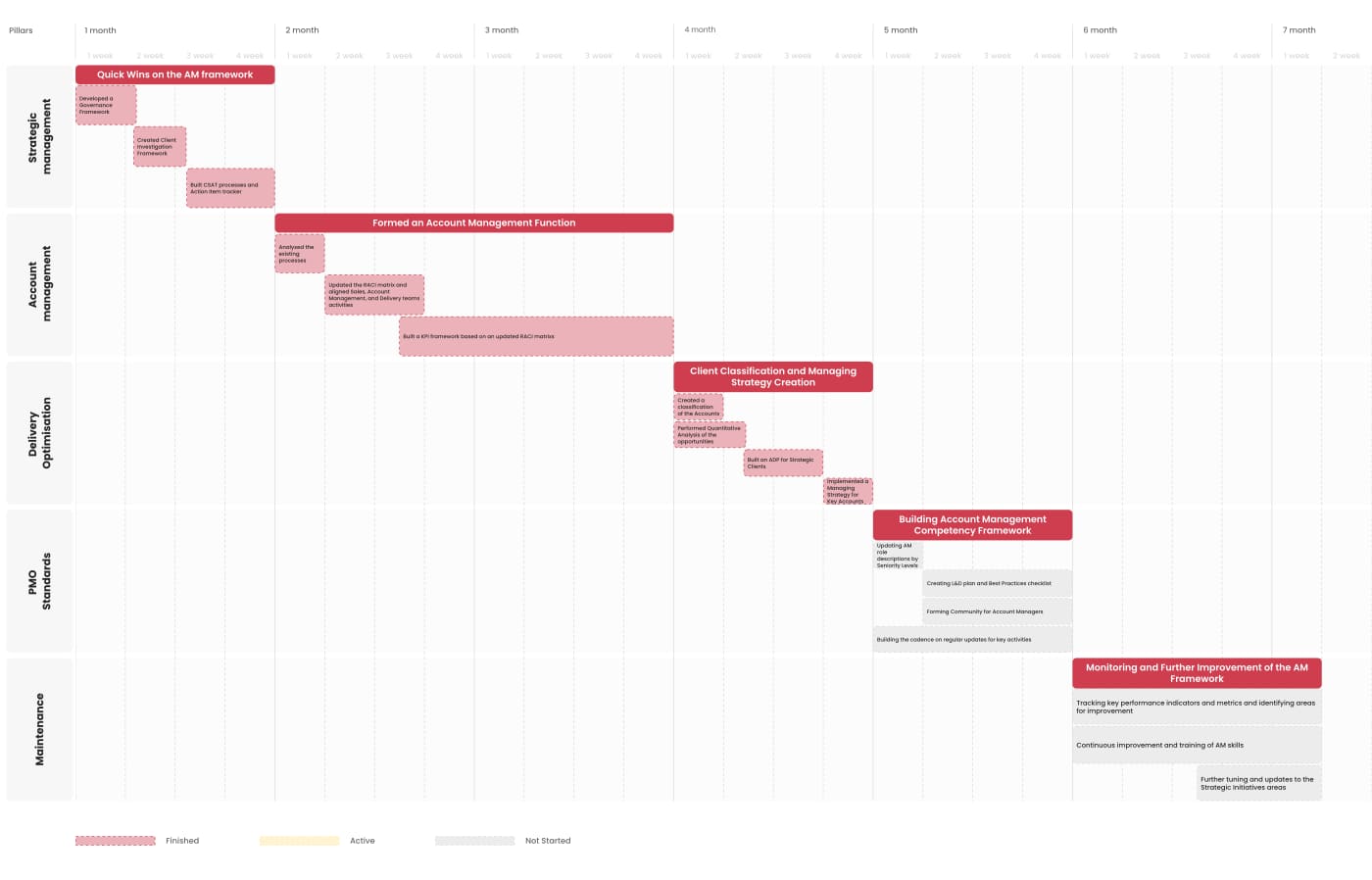
Before Artkai could implement ADPs for enterprise clients, they had to establish an AM process first. Anna stepped in to help Artkai build it from the ground up, defining AM roles, creating templates, and teaching the team how to manage large, strategic accounts.
”The most valuable part [of this project] was having someone who knew exactly how to do what we didn’t.”
Andrew EfremHead of Partnerships at ArtkaiThe solution
Below is a breakdown of Anna’s solution and the key areas the Artkai team had to master to reach their two transformation goals.
Anna didn’t just offer isolated fixes. She proposed a complete framework to build Artkai’s account management function from the ground up.
The approach was simple: give the team the tools and knowledge they needed to confidently work with enterprise clients.
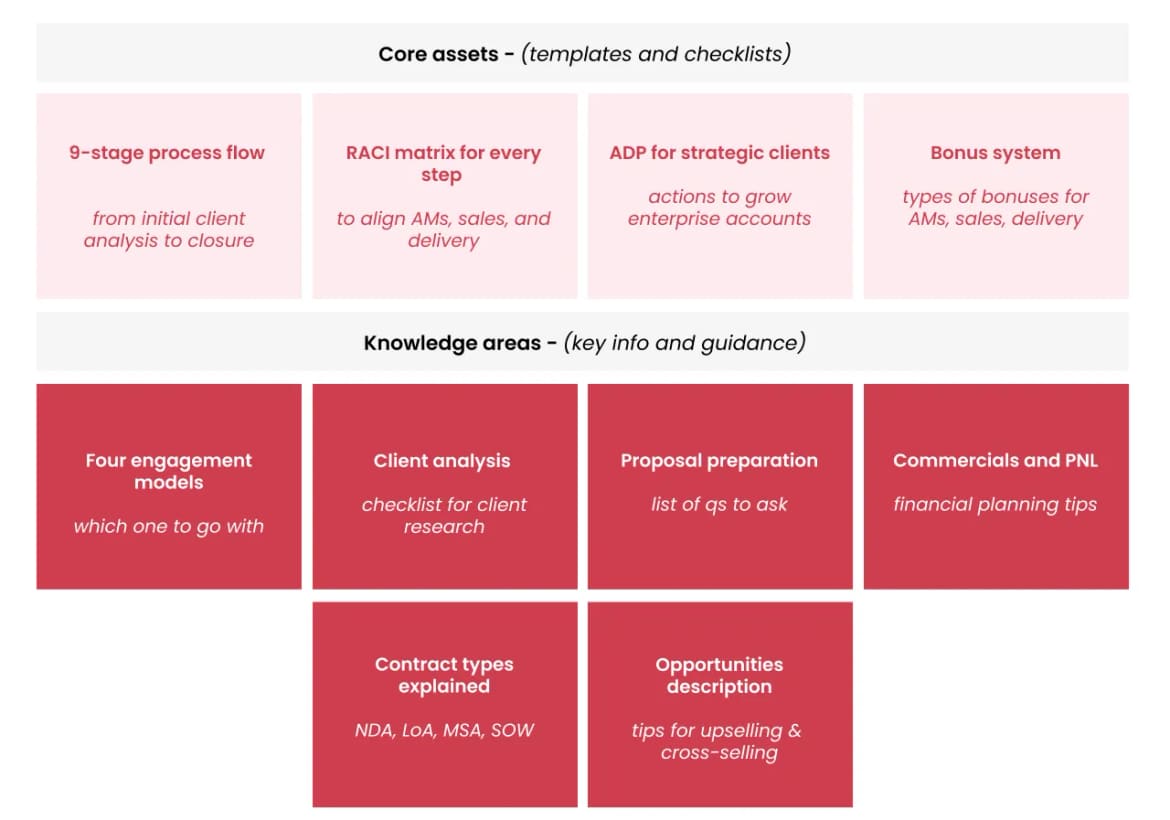
The framework has two key parts:
- Core assets: ready-to-use templates and checklists that cover the full account lifecycle. These include an AM process described in nine stages, RACI matrices to clarify roles, an ADP (Account Development Plan) to grow key accounts, and a performance-based reward system.
- Knowledge areas: the know-how AMs need to operate in enterprise environments – from engagement models and contract types to pricing strategy and proposal planning.

Recommendations
Objective 1: Equip the team to work with enterprise
Action #1. Build a replicable process to handle complex clients
Anna presented a 9-stage flow that walks AMs through the entire account management cycle, from the first client analysis to project closure.
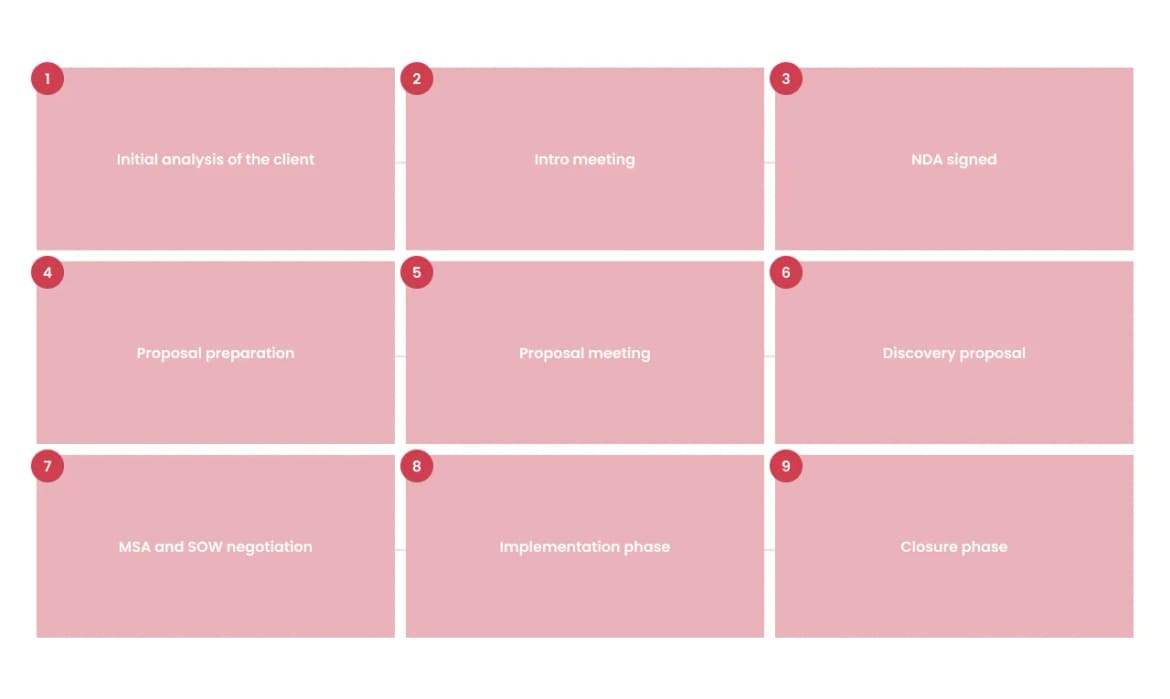
This way, every AM follows the same steps. With this structure, the team knows the flow to manage their largest accounts, which make up over 40% of revenue, and is prepared for the next wave of enterprise clients.
Action #2. Teach key enterprise concepts for every stage
Anna mapped core knowledge areas to each of those 9 steps. This includes information on engagement models, contract types, proposal strategy, pricing, and forecasting tips, as well as best practices for escalation, upsell, and governance.
Now, Artkai AMs know how to:
- Investigate the client’s structure, strategy, and key stakeholders
- Navigate legal steps like NDAs, contract flows, and internal approvals
- Build financially sound proposals using P&L modeling and margin forecast
- Run structured discovery phases with proper BA inputs
- Monitor success metrics, forecast revenue, and update account plans
- Lead proposal meetings and spot upsell opportunities
- Run intro meetings with clear value messaging and proposal questions
- Collaborate with PMs, BAs, and Delivery during pricing and scoping
- Select and negotiate the right engagement and contract types
- Manage project wrap-up, handovers, and long-term client relationships
Action #3. Clarify who owns what
Anna rolled out RACI matrices across AM, sales, and delivery teams for outstaff and outsource projects. It helps the Artkai team clearly define who is Responsible, Accountable, Consulted, and Informed during every step in the client management process.
Now the team knows
- Who should lead each step (e.g. AMs lead proposals)
- Who is responsible for legal or client escalations
- When to bring in sales, recruitment, or the CxO
- Who needs to be kept in the loop at each stage
- Who to involve for advice
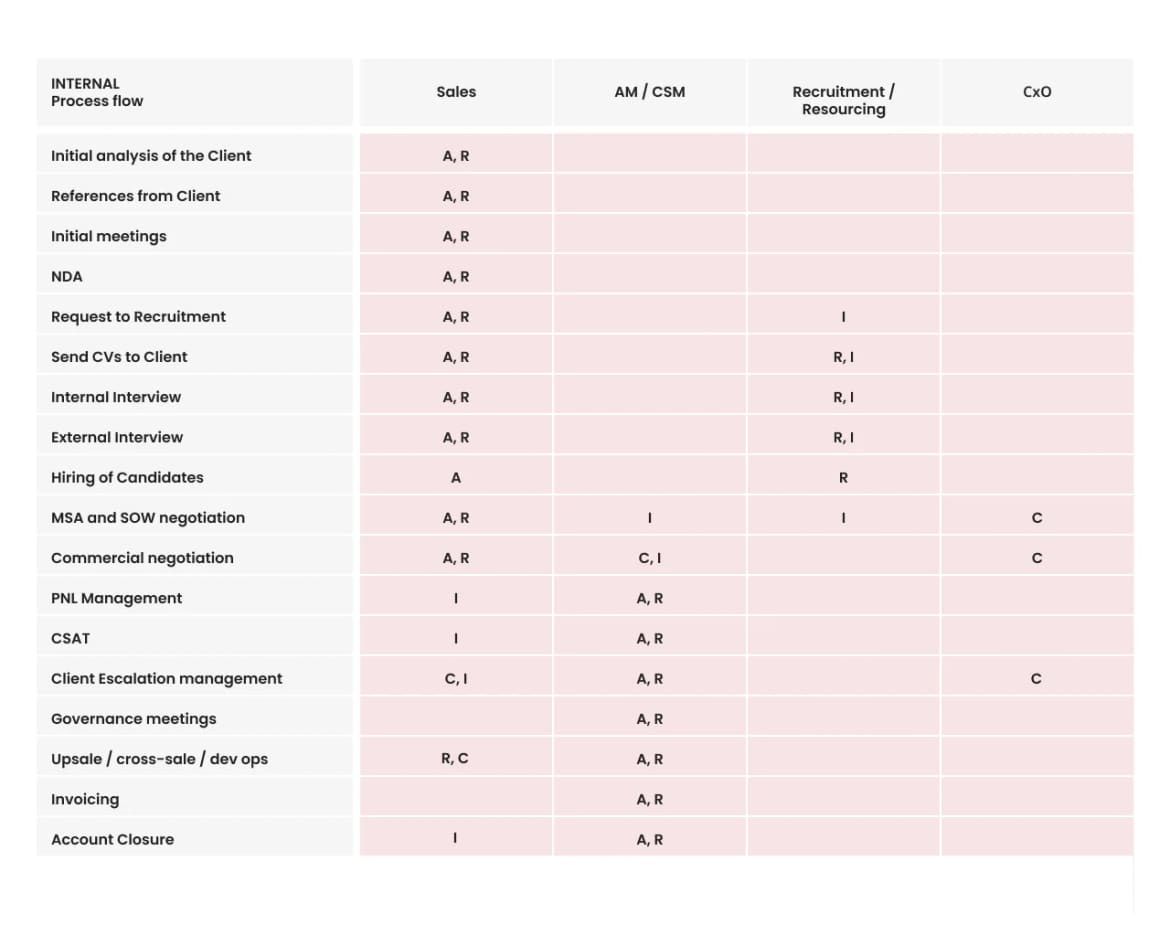
Now, no one will drop the ball because they “thought someone else was handling it.”
Objective 2: Make AM function profitable
Action #1. Roll out Account Development Plans to grow enterprise clients
With Anna’s guidance, Artkai filled out their first Account Development Plan (ADP) for one of their enterprise clients. Anna provided the template, explained how it works, and walked the team through it step by step.
Anna’s template walks the team through three key steps:
- Understand the client: Map out the client’s strategy, org chart, initiatives, and competitors
- The client and us: Link client needs to Artkai’s offerings, case studies, and strategic partners
- Build a plan: Define a revenue forecast and outline specific actions to achieve it.
Now that they’ve done it once, the team is equipped to use the same approach on other accounts independently and plan account growth.
It’s already paying off: using this approach, Artkai identified and structured 10 new opportunities within that first account – a strong start, even before the revenue kicks in.
Action #2. Motivate results with a performance-based bonus system
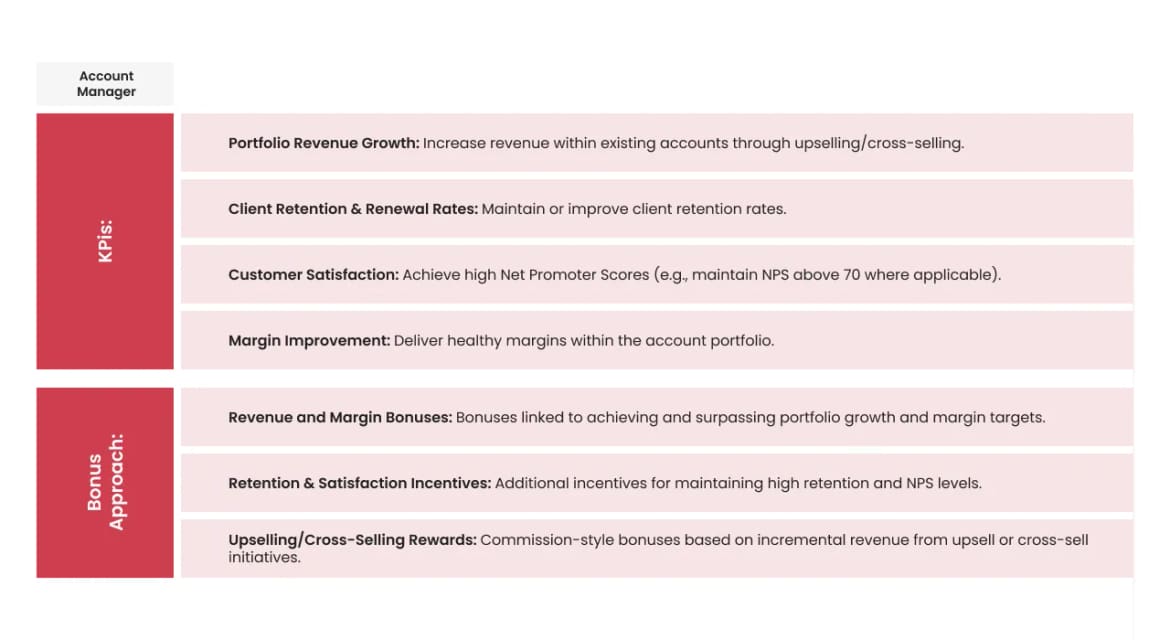
Finally, Anna introduced a structured bonus system for AMs, sales, and delivery. It gives everyone clear targets and shared motivation.
For AMs, bonuses are calculated using:
- A fixed part based on meeting revenue, margin, and NPS targets per account
- Additional incentives for upsells, cross-sells, and margin improvements on strategic accounts
For Sales and Delivery teams, bonus formulas are aligned with their role-specific KPIs, including:
- Conversion rate, deal size, and forecast accuracy for Sales
- Account health (“green” status), revenue, margin, and NPS for Delivery
”Before Anna, we relied on intuition. Now we have structure, templates, and a clear plan for working with enterprise clients. We had someone who knew exactly what to do – and showed us how.”
Andrew EfremHead of PartnershipsHave a similar challenge? We can help!
Business impact
The result
Artkai and Wiseboard continue working together in an on-demand format. So far, Artkai has achieved the following results:
Be our next success story
Explore more case studies

Read how fixing delivery and creating a stronger AM system helped Temy grow existing client revenue.
Case by Temy

Read how Linkup Studio moved from unpredictable margins and fragmented delivery to record monthly revenue with standardized processes.
Case by Linkup Studio

Read how Wiseboard redesigned CorpSoft's delivery structure and operations, doubling client satisfaction and creating a referral system.
Case by CorpSoft